|
|
 |
|

Napoleon Hill Foundation
Click here to subscribe to
Napoleon Hill Yesterday and Today

|
|
|
|
|
 |
|
|
No one is so good that he has no bad in him, and no one is so bad that he has no good in him.
We human beings are a complex lot. Many religious writings and great literary works are based upon the constant struggle between good and evil that goes on inside every one of us. This struggle is as old as mankind itself. Yet, while we recognize our own inner struggles, we are often quick to condemn others. Psychologists tell us that there is no such thing as a bad person; there are only bad behaviors. Make it a point to look for the good in yourself-and in others. Nurture the good character traits and work on the ones that may need improvement. Like plants in a garden, the character traits that grow strong and productive will be those that are fed, watered, and weeded regularly.
-Napoleon Hill Have you been inspired by Dr. Hill's words? Click here to subscribe to Napoleon Hill's Thought For The Day. ¿Le gustaría recibir la "Reflexión del día" en español de la Fundación Napoleón Hill? Haga clic aquí. |
|
|
|
|
|
Can you
see this |
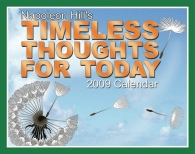
“Self-disciplined begins with the mastery of your
thoughts. If you don't control what you think, you can't control what
you do. Simply, self-discipline enables you to think first and act
afterward.”-- Napoleon Hill Click here to order your
Calendar today...
|
|
 |
SUCCESS
Symposium
Imagine if one day could change your life forever. Saturday, March 28, 2009, could be that day. Whether you want to make a small improvement in one area of your life or give your life—and business—a complete overhaul, this one day could make it happen.
Thousands of people traveled from 20 countries to attend the Symposiums held in 2008. More than 3,000 motivated achievers will head to the 2009 SUCCESS Symposium at the Sheraton Hotel in Dallas to gain pivotal insights and inspiration from the top personal-development experts in the field. Will you be there?
Click here for more information on the SUCCESS Symposium
|
|
|
 | |
Dear Readers:
As an English Major in college, I was assigned to read the short story entitled “Bartleby the Scrivener” by Herman Melville. Melville wrote this work after authoring the classic novel Moby Dick. Bartleby was the main character in the story, and he was an unusual one. One day after being employed as a copywriter in a legal office he was given an assignment and his simple response was, “I would prefer not to.” Over time, this became his usual rejoinder, much like a mantra. This bewildered everyone, and answers were sought that would explain his behavior. Sadly, the situation worsened, and predictably Bartleby “preferred” himself right out of life. As the story concludes, the reader is forced to wonder why Bartleby decided not to decide. Did he believe his non-decisiveness was creating a safety net around him, or did he feel that by not deciding he was asserting his independence? Whatever his rationale, in the end he was the loser. His lack of deciding self-selected him for extinction.
There are obvious advantages in being flexible. In decision making flexibility is akin to creative visioning. Being open rather than closed to what the Universe brings to our doorstep places us on the receiving end. Receiving works best as a reciprocal process. To quote St. Francis, “It is in giving that we receive.” You give to receive and receive to give. Just as a seed is planted, grows, and it harvested producing more seeds to be planted, your life should do the same. Suppressing this process stunts our growth and hastens our demise. By being flexible, we remain youthful, supple and growing. When we interfere with the process, we begin to deteriorate and die.
Decide not to be rigid, but flexible. Do the unexpected. Take a risk. Accept a challenge. See what the Universe brings to your doorstep. And, who knows? You may just catch a falling star, capture a leprechaun, rub the magic lamp, and really find your pot of gold at the end of the rainbow just as we read about as children. But, you won’t do this unless you are flexible enough to reply as winners reply, “Yes, I can!”
Be Your Very Best Always!
Judy Williamson
|
|
| |
|
|
| |
 |
Flexibility Can Produce Miracles
by Napoleon Hill
Throughout his long and interesting career, Napoleon Hill has met with, talked with, and studied the world’s great. What he has learned from them he passes on to you—along with his own wisdom. Few men in history have been able to influence the lives of so many people for the better as has Napoleon Hill. His writings, among them “Think and Grow Rich,” “The Science of Success,” and “How to Raise your Own Salary,” his lectures, his radio programs and motion pictures have helped countless thousands to help themselves.
Andrew Carnegie, founder of the great United States Steel Corporation, was probably the best judge of men of any industrialist of his time. He was responsible for the success of more men than any other man of his time.
When Mr. Carnegie wanted a man for an important job, he looked for these traits before hiring him: A keen sense of loyalty—dependability—flexibility—and lastly, ability to do a given job well.
Mr. Carnegie said that if a man were not loyal, dependable, and flexible, no amount of ability could qualify him for a responsible executive or supervisory position. By “flexibility” he meant the capacity to adapt one’s self to emergencies and rapidly changing circumstances without losing his poise or permitting himself to be thrown off balance through anger.
He illustrated his point by relating an experience he had with his chief chemist. He wanted the most able chemist that money could hire, so he sent a talent scout to Germany to look for such a man and found him in the employ of the Krupp Gun Works. It took a fabulous salary and a five year contract to break the man away from the Krupp Works, abut he was hired and brought to America.
By the end of the first month after the chemist became a member of Mr. Carnegie’s master mind group, it became apparent that a mistake had been made in hiring him. The man was, without a doubt, the ablest chemist Mr. Carnegie had ever known, but he had a static, stubborn disposition which made it impossible for other members of the Carnegie organization to get along with him, so he was paid off for the entire five-year contract and dismissed.
One of Mr. Carnegie’s executives remarked that this had been a very expensive experience. “Yes,” said Carnegie, “but not anywhere near as expensive as it would have been if we had not dismissed him.” This was one of the very few times when a man had been chosen for an important position in the Carnegie organizations without having been analyzed by the great industrialist.
The most common of all the causes of individual failure is one’s lack of ability to get along with other people. Flexibility cures this weakness. No two people are alike in their personal traits and mental attitudes. The successful person recognizes this fact, and he also recognizes that the cannot make other people over or change their mental attitude to suit his convenience, so he changes his attitude temporarily to avoid conflict with others.
We have ears with which to listen and mouths with which to speak, but fortunately we do not have to speak every time we hear something we do not like. Silence can be a powerful weapon, and it is often used by wise people when they are in contact with others who are irritable or inclined to create unpleasant incidents of an argumentative nature.
The late Franklin D. Roosevelt was one of the most flexible men I have ever known. He could be all things to all men with the greatest of ease, and it has been said that this trait of flexibility was his greatest asset and the one thing which made him the most successful politician who ever occupied the White House.
I have seen men come into President Roosevelt's office roaring like lions and after he got through with them they walked out like lambs. One day a very prominent banker came to see the President. He was as mad as a "wet Hen" because a member of the White House staff had kept him waiting what he thought was "too long." Before he was even seated he started right off to air his peeve by saying, "My time's important, and I don't like to have it wasted by flunkies."
Roosevelt turned on that million dollar smile of his and said, "Well, I know just how you feel, for my time is also important, or I am fooling a lot of the people very badly." The caller smiles, apologized to the President, and said, "I would give a million dollars if I had your flexibility." And he probably would have done so gladly.
Hardly a day goes by without experiences in everyone's life which could be blown up to great magnitude of unpleasantness if one does not have the flexibility with which to neutralize them.
There are more than thirty individual traits which, when combined and applied, give one a pleasing personality. Flexibility is a "must" in this group, for without it no one can get along harmoniously with others at all times under all circumstances.
I was destined to learn, during the twenty years of labor I put into the research in organizing my success philosophy, something of the importance of flexibility. I need flexibility on many occasions in order to adjust myself to the need of money. And I needed it in order to convince the five hundred or more top ranking business men and industrialists who collaborated with me in creating the philosophy that their time was wisely spent in helping me.
Flexibility is the answer to almost every unpleasant circumstance with which we meet, and it can best be made to serve during these emergencies if we remember that every adversity carries with it the seed of an equivalent benefit. You can very well determine whether or not you have flexibility when adversity overtakes you. If you have it, you will begin at once to look for that "seed of an equivalent benefit" instead of allowing yourself to be thrown off balance by fear, self-pity, anxiety, or resentment.
In order to remain flexible during the early part of the depression which began in 1929, I wrote books. I had no idea of having them published. I wrote merely to maintain my flexibility. However, three of my friends adjusted themselves to the circumstances in a different manner. One of them jumped off a high building, one shot himself to death, and the third "solved" his problem with an overdose of poison. My financial losses due to the depression were as great as those of any of my three friends, but I had one asset which, unfortunately, they did not possess.
One thing I have learned from life's experiences stands out in my mind above all else as a great blessing. I have learned that no experience and no material loss are important to anyone as long as he remains in contact with Infinite Intelligence and keeps sufficient faith in himself to be guided by this Divine source of power. This, too, is flexibility applied, and it often carries convincing evidence that experiences we sometimes regard as irreparable adversities turn out to be blessings instead. For it is true that an all-wise Creator has provided that none may experience a loss of any nature whatsoever without the potential of an equivalent gain in one form or another.
Flexibility gives one the capacity to recognize that whatever the mind can conceive and believe the mind can achieve. And it also gives one the wisdom to recognize that TIME is the great universal healer which can cure most human disappointments and frustrations, and the courage to recognize that strength, physical and spiritual, grows out of struggle.
Source: Success Unlimited. September 1955. Vol. II, No. VII. Pgs. 8-11.
|
|
|
| |
|
|
|
 |
Flexibility: A Major Key to Success
By Jim Connelly
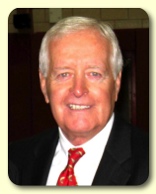
Jim Connelly
Napoleon Hill has been my hero since I was first introduced, as a young man, to his life changing book Think and Grow Rich. Up until that point, I was a street fighting kid from the projects of Western Pennsylvania who’d just gotten a job at the Beverly Wilshire Hotel as a Room Clerk.
If Dr. Hill were right – that every adversity carries with it the seed of an equivalent benefit - then my economically challenged upbringing under the rule of a mean alcoholic father must have a benefit somewhere. It didn’t take me long to find it. I had two things going for me: my strong work ethic and my ability to “roll with the punches.” As Napoleon Hill would say, I had “flexibility.”
Dr. Hill defines flexibility as “the capacity to adapt one’s self to emergencies and rapidly changing circumstances without losing his poise or permitting himself to be thrown off balance through anger.” As a very young boy in a dysfunctional family, I learned very early on what it meant to be flexible. Many nights I would be rudely awakened by one of several alcoholic uncles who needed a bed to “sleep it off.” They’d say “Get up. Go find somewhere else to sleep” and if the couch were available, I’d grab it. Otherwise, it was the floor for me. Now I remember why I spent so many nights away from home. I can’t say that I wasn’t angry each time this happened, but I can tell you it prepared me well for the curve balls that life would throw me on a regular basis.
Throughout my career at the Beverly Wilshire Hotel, I first survived, and then I thrived because of my ability to adapt to any given situation. Whatever reasonable need our clients had, I made sure I found a way to fulfill it. Some might call this particular request a little unreasonable, but I’ll never forget the time Elvis Presley was a guest at my hotel and wanted a pool table in his room. He and his buddies wanted to be able to play any time they felt like it. The problem was it was Sunday evening and all the stores were closed and I was tired and ready to go home after a long work week-end. But Elvis was a faithful client of our hotel and I wanted to make sure he continued to be.
By that time I was the General Manager of the hotel, so I had developed many friends and contacts in Beverly Hills .Through some connections I obtained the private telephone number of a pool table store owner and told him I needed to rent a pool table for a week. He agreed and had the table delivered that night. Elvis’ room was on the 10th floor and that was a big problem. I gathered all my strong guys who were just leaving to go home, and lucky for me, they were very flexible that night as well. Through amazing feats of strength, slick maneuvers and much blood, sweat and tears, we delivered the pool table through a cramped service elevator to his room that night. Elvis was very grateful and actually humbled by our efforts.
I could easily have told him that pool tables weren’t allowed in guest rooms or that all the stores were closed and would have to wait until tomorrow. But I knew that through this one big moment of being “flexible”, there would be great dividends to follow. The result was that not only did Elvis keep returning to the hotel, he referred countless others to us as well.
Another example of flexibility occurred just this past week, when a young man came to visit me. He is a student from China attending Purdue University in Calumet. He has a dream and a vision and he needed some guidance in developing a plan to achieve his goals. Like me, he is a student of Napoleon Hill's philosophy and believes you can do whatever you set your mind to. It starts with a clearly defined goal and a plan of action which becomes your road map. Well, his road map began with a bus ride from Calumet to Notre Dame (which he had never heard of) to meet with me. He adjusted his schedule to take a 2 hour bus trip on a very cold day, on roads that weren't that great, to an unfamiliar place, where few if any spoke his language to meet with a man he had heard speak only once before at a Napoleon Hill World Learning Center workshop. He showed great flexibility in stepping out of his comfort zone to find some answers that would help put him on target to reach his goals. I admire this young man and I know he will be very successful with his can-do, flexible attitude.
Flexibility is one of those qualities that is absolutely necessary for success. The world is changing so fast in so many ways, that to be able to adapt, to be flexible, is an absolute survival skill. Today I hold live MasterMind events in South Bend, Indiana several times a year. As the group interacts, I watch for flexibility and adaptability. If life throws an unsuspecting set of circumstances at them, do they adapt or do they complain? Do they roll with the punches or do they stand with their feet stuck in the mud? The most successful members of my MasterMind teams are those who do more listening than talking and learn with an open mind and heart. There is no doubt they can achieve whatever they conceive and believe, even in today's economy. As Napoleon Hill said, with any adversity, we must look for the "seed of an equivalent benefit" They realize there are solutions to just about everything if they are willing to be flexible.
For more information on Jim Connelly’s MasterMind Weekends go to www.mastermindchampions.com. Or contact Nina Hershberger 574-320-2522.
Thank you Jim. To submit your own Guest Column to be included
with Napoleon Hill Yesterday and Today, please contact Gill Kilcoyne
via email pma@gitomer.com or call 704
333-1112. |
|
|
|
|

For advertising information please contact Gill Kilcoyne here
pma@gitomer.com
|
|
|

|

|
|
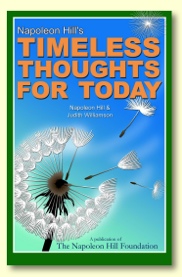
Napoleon Hill's
Timeless Thoughts
For Today
As a student of Dr. Hill for many years, I know that his philosophy works best when it is observable and measurable. This means that in order to achieve desired results, a simple two step process must be followed:
Step 1: Thought
+
Step 2: Action
=
SUCCESS
It is not always easy to take action, but without action there is no success. Reflect on this for a moment. Great intentions never measure up to the smallest action. However, the tiniest action begins to build a momentum that culminates in your desired success if you build on the previous action daily.
Napoleon Hill's Timeless Thoughts for Today pairs Dr. Hill’s philosophy with actions that will move you toward success. I suggest that you try a few, keep a log, and watch your success rate grow. Without the action step, you are missing the master key to
your dreams.
First chart your course, next plan your method of travel, and third, step into the journey and begin! As you progress, you can then evaluate what actions work best for you. Look at this book as your treasure map. When you follow it to your destination, you will be rewarded with finding the treasure you seek.
Special Offer!
Purchase Timeless thoughts for Today and get a 2009 Timeless Thoughts calendar for only $5.00
For ordering information Please contact Chino by clicking here
|
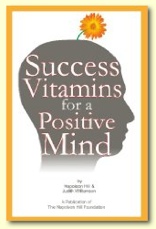
Success Vitamins for A Positive Mind
By: Napoleon Hill &
Judith Williamson
This collection of over 700 proverbs written by Napoleon Hill is both sound and practical because these mind conditioners have worked successfully for those who have used them. This collection was prepared especially for students of Dr. Hill's Science of Success Philosophy with the explicit hope that each person who reads it may be enriched in body, mind, and spirit.
Order your copy now from Amazon.com by
clicking here
|
Paloma
by: Rich Winograd
Written in a simple and beautiful style, this is a story of a little
girl who teaches us great spiritual principles. It’s about power of
hope, strength of faith, learning from adversity and about love. Once
you start reading it, you will not be able to put it down. -Andy Bienkowski, co-author of Radical Gratitude
Once in a while, there comes a book so beautiful, so filled with love, so filled with faith, no one should miss it. Paloma
is that story. Paloma is a beautiful and precious dove, multi-talented,
filled with life and love. Elida, Paloma's mother, recognizes that fact
from the time of her birth and forms a deep and special bond with her.
Every mother, teacher, parent, grandparent, and anyone who wants to be
a parent should read this story of love and faith. -Barbara Gardner, MEd. Click here to order yours now! |
The Little Teal Book of Trust
by: Jeffrey Gitomer
Who do you trust? Who trusts YOU? This book has answers that will
inform you, alarm you, entertain you, reinforce you, and give you the
tools you need to build and keep this most valuable personal and
business asset.
TRUST in countries, governments, corporations, and individuals.
TRUST in products, services, claims, speeches, commercials, and ads.
TRUST in clergy, sports heroes, teachers, firemen, and police.
TRUST in healthcare, economies, newspapers, books, and the internet.
TRUST in families and friends.
This breakthrough book defines trust, relates trust to truth, tells how
to gain trust, how trust is lost, shows examples of trusted
relationships, and how to rebuild trust. And for salespeople this book
shows how to build loyal relationships and become a trusted advisor –
written in Jeffrey's straight-forward style you have come to know – and
yes, even trust.
Buy The Little Teal Book of Trust TODAY!
|
|
|
|





